Wednesday, 11 March 2009

Basics

These past 2 months passed without me touching a brush or drawing tool, except for a weak attempt at a sketch on a hike here and there.
The first three sketches were done on different days on different hikes;

...a walk in the coutryside of Esvres where we crossed the roman bridge which was apparently crossed by Jean d'Arc in 1429 to get across the Echandon valley...
...sketching the photographer while he was executing his professional tricks...

...and lastly a lake at the Beaufoux estate with its calm waters and willows, the boats waiting patiently for summer to erupt...
I wanted to show up here with a beautiful watery painting of something watery, but helas, I am showing up instead with my process of relearning. My well intentioned painting resembles something of the French revolution on gray and busy guillotine days, so I hid it safely from the public eye.

While staring at my attempt, my professor of first year graphics, entered my somewhat desperate thoughts. He told me years ago that I couldn't draw. Our work was all put up on the board at the end of a day for critic and when he came to my "driftwood and key" still life, he was very silent. Then he turned to me and said abruptly that I can't draw and need to do 100 more drawings, on top of the already 100 drawings we all had to do. The tools were simply to be cheap white paper and any tool except the normal pencil or graphite or charcoal or brush, like ear buds, cottonwool, sticks, pins, needles, toothbrushes, etc, along with cheap black ink. We had to really dig in with the ink and get our hands dirty and draw, draw and draw. Not be fancy or pretty or dainty or finicky, but convey our subject/object on our paper by various marks, shapes, values. It was invaluable teaching, al those hours of drawing, which admittedly, I sometimes(more than sometimes!) did with heavy sighing and stubborn shoulders.

This morning I took my professor in my head along to the river. Cheap drawing paper. Cheap ink. My chair. I sought out a spot down stream with several interesting views. Gathered some sticks, stones, leaves, bundles of grass which served as my painting tools. The first attempt was still stiff and careful but by the third drawing I started loosening up and just focused on marks on the paper. The rocks in the water started losing their name and became dark shapes, the water ripples became squigly lines, the trees became thick lines and featherings, the grass became patches...

Hopefully the ice is now broken so I can provide a real painting next time!
But for now;
...the corner of the river where I painted..


...a shot on the tools and materials...
...and three of the many efforts from this morning...

Monday, 9 March 2009

More Mud Works


10" x 10"
Watercolor, ink, mud and silver acrylic ink on paper

I recieved such wonderful, enriching comments on my mud post that I thought I'd consolidate them into one large mud resourse. It also is the way I got everyone else in the group to write my post for me this month. ;>)How much more support can a person ask for? So here goes:

Vivien recommended looking at Australian aboriginal art

Vivien also had the following mixed media recommendation: "I have used sand in mine when I've been at the beach, deliberately incorporating it into oil paint - mud looks interesting"


Laura recommended the work of Richard Long : "I saw one of his circle paintings made with mud from the River Avon at the Heyward Gallery in London, round about 1993, and was moved, deeply and inexplicably."
Laura was also reminded of the work of Andy Goldsworthy.


Katherine responded with some really great links:
Richard Long's web site

And her link for Richard Long's newsletter which lists all the permanent exhibitions

If you'd like a little background information, you can read more about hiim here:
Wikipedia for Richard Long

Katherine also recommended that I produce a demo "on how clays in different places have different colours?"

After reading Katherine's comments, Larua recommended this book:Colors of The World


Gesa commented:" With a friend we did a series of experiments with mud/sand and emulsion paint and trying for different flow, speed etc."

Sarah shared the work of this guy's beautiful work :"Paul Lewin, an artist from Beside the Wave has been using the clay from where he is working to draw with. I think adding a bit is a little bit of magic, giving a sense of place on another level, even if it is just water."

Jeanette added yet another artist who uses mud and on this link, she explains how she bonds the mud to her substrate.


Ronell shared some wisdom from her beloved South Africa:"It (using mud) also reminds me of the bushmen(san) rock paintings, where they've used mud as a painting medium, bird droppings for white, charcoal for black rock and blood to colour their "paints"...some of their many materials. And how about egg white to bind the mud? Or even beeswax as you would do with restoring furniture. "

And two visitors contributed to the discussion also:

Armella Benton Studio recommended using Utrecht's modeling paste extender as a way to stabilize the mud.

Sydney Harper recommends looking at artist Jean Schulman who does batik paintings with different colors of local clay.


In the mean time, I've found yet another artist who uses clay, Deane Huff. She uses a unique process of mono prints on a clay slab using colored clays.


Thanks one and all for your muddy help and for writing my post today! We really are a "dirty" bunch.


Normally I don't double post on my blog but I can't pass up the opportunity to list all these great muddy ideas. I've also posted another muddy image on my Blog in case you want to see.

Sunday, 8 March 2009

Water On My Mind

There has been a bit of reflection going on here, I have been away for far too long and decided that this morning I must catch up with some bloggery.


First of all time to tidy up my Flicker photos and, getting side tracked as usual, I made a slide show from the set I labeled "water" It is quite a big set of images of paintings that I have done since June 2006, featuring the subject of water. In streams, rivers, seas and puddles, in watercolour and oils. I think I have developed a bit of an understanding of water, I know that I have watched and noted, tasted and recorded to the best of my ability. I have found out ways of using different mediums and what I like to use and what I do not feel comfortable with. In short, I think I know how I work now.

I am finding that this group of artists is a constant source of interest and information. I am fascinated to see the different ways of working. Some are methodical, mapping their routs and understanding their mediums. Some delve into the history and geography of a place. Some carry the art history seemingly effortlessly into their work and beyond. Some dive in with an intelligent grin.

We are all so different and this seems to be emphasised by the umbrella of water as a theme while at the same time uniting us. Strange but true and , well, I for one like it very much. So thank you to my fellow watery artists, I am now going to get me a coffee and spend some time catching up with what you have all been up to.

(I dont know what has happened to the slide show, it dosnt look very posh but if you click it you can see it, I think!)

Friday, 6 March 2009

The waterways project so far


The waterways project so far ........

As the weather gets warmer (my arthritis doesn't like this cold :>( ) I want to get a lot more work done on this project. It was always intended to be a slow burn project but it's a little too slow burn at the moment!

The beautiful huge willows that overhang the water in the charcoal sketch of the 15C packhorse bridge are now the sad pollarded stumps of the lino prints and pastel. Though interesting to draw, the landscape is poorer for their loss. I know they will grow again but it will be a long time before they regain their beauty.

So far I've only looked at Aylestone Meadows, the canal marina at Market Harborough and countryside nearby and the city centre with its old factories and weirs.

I've looked at aerial views thanks to mapslive.com and I'm interested in taking them further at some stage. They show you the context - how the bridges and rivers, canals and streams relate to each other.

In the Charnwood Forest area are old slate quarries, now flooded and surrounded by trees that I want to look at soon. Rocks and depth and craginess - something quite different from the tranquil canal.

update: link to oldest fossil found in that area in really ancient rock

So many things I want to do - I just need the time.

Tuesday, 3 March 2009

A sketchy hint of things to come!

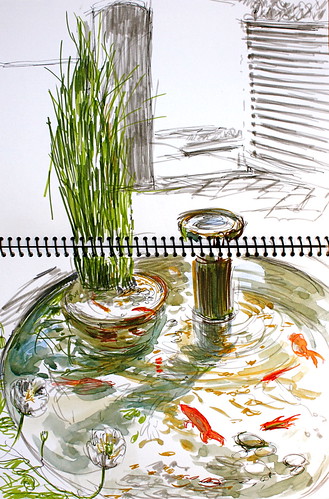
I mentioned I'd found a watery place to go and paint about two 1/2 hours from here and I'm SO excited! In the meantime, here's a not unrelated (got that?) sketch I did last week in Austin, Texas. Sometimes painting is the most fun thing in the world to do! (Sometimes it's hellish, but we'll leave that thought for another day.) I 'll be at the Mystery Place a week from this weekend, if the weather's good. Cross your fingers for that good weather, please!San José Hotel fish pond, Austin, TX.

Sunday, 1 March 2009

collage experiments


High Tide. Vivien Blackburn. Collage/mixed media in a little moleskine

Sometimes it's nice to 'play' as Jeanette is doing with her lovely fish - trying out something different, experimenting, getting away from what you normally do and discovering new ways of working, new marks to make, new visual language that can feed into more finished work.

These are some of the collages that I've been playing with in sketchbooks - the idea for first one was triggered by some lovely marbled wrapping paper that Lindsay had sent with something - it just needed to be used :>) It wouldn't be light fast enough to use in a 'finished' work but it's great for experimenting in sketchbooks. I also used fragments of brown paper and the brown tape you seal the backs of frames with, for the rocks. Then a mix of media for the rest including cp's and oil pastel.

I cut up and pieced the marbled paper to give the swirl and perspective of the waves and then scribbled and altered, covered or enhanced areas to try to get that swirl of waves crashing on sand and rocks.


Waves on smooth rocks. Vivien Blackburn. Collage, hand marbled paper and mixed media

The second one, Waves on Smooth Rocks, has been shown on my blog but I've reworked it so that it now looks rather different and I think reads much better. The paper in this one IS lightfast because it's some I made myself - yet another thing I want to try again when I can. I'm going to have a go at the shaving foam method that I've been told about.


Lino print on tracing paper (right hand page) worked into and continued onto opposite page, Vivien Blackburn, linoprint/mixed media

In the last one, the right hand page is one of the series of linoprints I've been working on. It was printed onto tracing paper - I was experimenting with various papers. Then it was worked into with coloured pencils, mainly Polychromos and Lyra, and the image extended onto the facing page,
This one makes me think of the mood in a Samuel Palmer painting, I don't know about you?
All of these have given me ideas for larger works and make me consider incorporating collage into finished work.

Tickling trout


I finally tracked down a rainbow trout to practice some more gyotaku with. It was like hitting paydirt. You'd never think a fish would be so difficult to find in this city! At least one that you didn't need a second mortgage to afford.

It took me awhile to get the hang of it and I used a lot of newsprint initially as I didn't want to waste good printing paper til I was happy with my ability to lift a half decent print from the fish.

Because its a three dimensional object that you're working with, its very easy to blur the lines and lose definition of the scales or fins.

I tried a couple of prints on cardstock to use as greeting cards then enhanced them with watercolour. I like the results as the fish wrap around the card making unique pieces.

After taking some prints and playing with colours and papers, the fishy smell was enough and I washed it off and wrapped it for the fridge to try again tomorrow. The shelf life of a fish isn't long, so can either use it for a few days or freeze and refreeze to prolong my ability to use this model. I think it will be the former as I imagine the solidity and skin texture of the fish would deteriorate after a few freezings and thawings.

Edited: I've enhanced a couple more of the prints, or half prints to give an idea at high resolution what they look like.