Showing posts with label fish. Show all posts

Tuesday, 8 February 2011

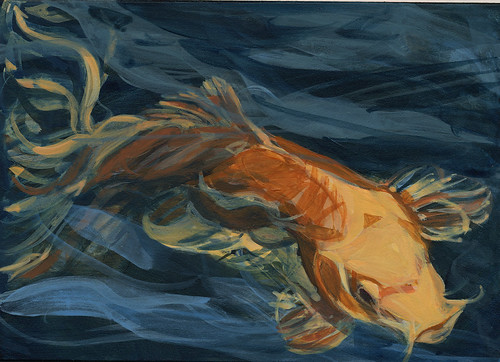
Koi painting in oil.

I finally completed one koi painting in oil.

Although I'm happy that I stuck to it and completed at least one painting of the koi, I definitely plan to go to the koi farm in summer, where I can seat myself for a day and really get to work on some series. Studying the koi here in January/February, felt a bit like eating strawberries in the midst of winter.

..koi, oil on linen, 61x37cm

In step 1, using terpentine, I put down thin washes of burnt sienna for the fish shapes and a thin wash of paynes gray and french ultramarine for the background/water.

....step 1...


In step 2 I added some colour to the fish, cadmium red and yellow to the fish in the foreground and prussian blue to the back fish, to form the shadows. I started using liquin as a medium to have the oi dry quicker, but still have an oil shine.

...step 2...

In step 3 I darkened the water with a mixture of paynes gray and french ultramarine and softened the shadow marks I made on the yellow fish. this was my first mistake, because I made mud. I left it to dry completely, so I could rework it...the oil was still thin enough to redo without removing the paint.

...step 3...
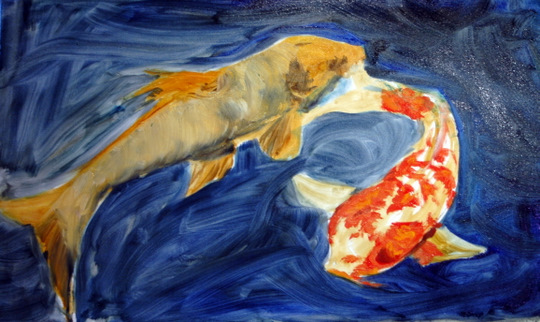
the last stages was all about adding colour and depth to the fish bodies and depth to the water , while using the same colours I've used in the previous steps, with the addition of ochre, raw umber and white.

...koi completed...
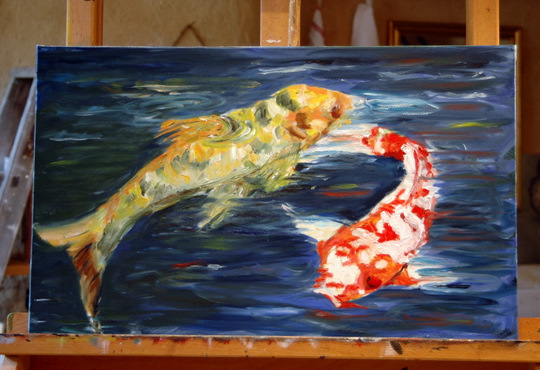
When doing the studies for this koi project, I worked mostly from photographs, using about 20 different photos, building my own scenes. I really found it difficult to render the koi in an interesting way. I feel I can do better, which is why I will patiently wait for the koi season to open and I can go and study them in real life.

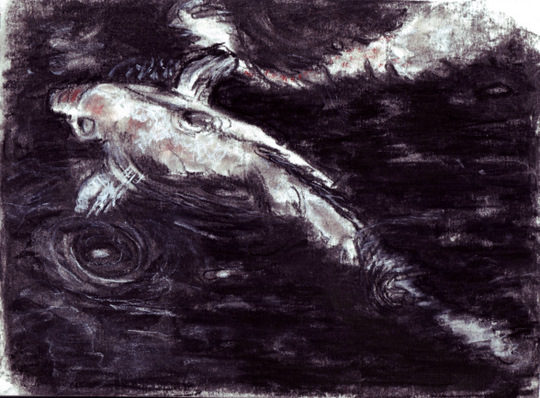
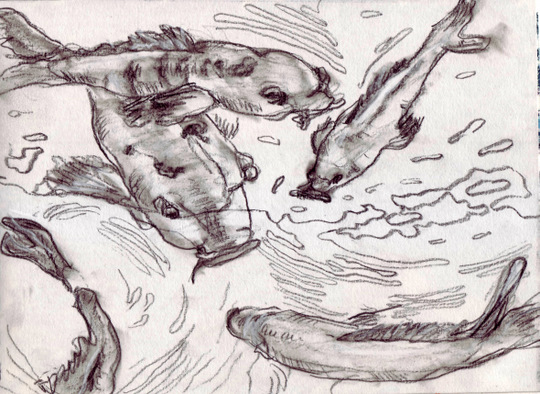
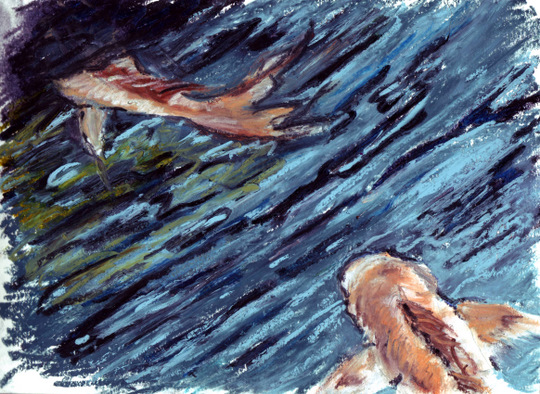
I also felt that they ask for something a little more abstract or expressive than mere realistic rendering. In the following studies I tried to present them on the page in a little more interesting way. I found it quite exciting and I think I can even push the envelope even further in the expressive domain, which makes me more excited about the series of koi than I was when I started out.

In the meantime, I have a lobster and crab and mussels and oysters and several other shellfish in my freezer, waiting to be sketched and painted and studied. Maybe a new series of sea creatures? So hang around if you're interested in seeing what will surface - it will be a surprise for me too.

...koi study in charcoal on paper, 22x15cm...

...koi study in graphite on paper, 22x15cm...
...koi study in oil pastel on paper, 22x15cm...
..à bientôt...

Ronelle

Africantapestry

Thursday, 13 January 2011

Watercolor Koi studies.

I have been taken with all my hundreds of photos I took of these koi fish when we were in Hawaii last year. The idea was to come back home and use them in paintings. But true to my nature, procrastination took over and the Koi were admired only in the photo album. Browsing the album lately rekindled that idea and here are some studies, done from the computer screen. When working from photos I always cramp up in tight spasm and lose all spontaneity. so after doing about two or three, I grabbed for my earphones and the Piano concertos of Beethoven 4 and 5 andPiano a La Roque dAntheron to keep me loose. I think in study 3, one of the earlier of 7 studies you can still see the cramped up tightness.
With some more studying of the Koi and their movements and habits and play, I would like to move on to oil and maybe do a series. I efintely want MOVEMENT in the paintings, because Koi are so playful and almost mischievous and I want to capture that, rather than a perfectly painted Koi fish.

Also posted on Africantapestry

All these studies done in pen and watercolor on Fabriano Artistico watercolor paper, CP, 18x26cm.

..koi study 7..


...koi study 4..


..koi study 2..

Sunday, 9 January 2011

Smoked undyed cod loin

I was just about to cook my smoked undyed cod loin for dinner when I read Ronell's post about her scampi and prawns.  It had never occurred to me before that I could draw fish for watermarks - after all it's Jeanette who does the fish! ;)

Anyway I thought I'd have a go - but since it meant delaying dinner this was a very fast sketch!

I have to tell you that I now believe painting the flesh of fish ought to be part of every painter's training - in learning how to see colour and the subtlety of colour.  The colour changes are so subtle that I think anybody who mastered painting the flesh of fish would find painting flesh for portrait painting an absolute doddle!  Who knew?

This is a very imperfect sketch of my dinner - uncooked and on a pale duck egg blue plate - although I only had half for dinner!

Smoked undyed cod loin
coloured pencils
Katherine Tyrrell

Friday, 29 October 2010

Sometimes you have to look long and draw fast!

Volissos Fishing Boat (Pastel 19.5" x 25.5")
I don't know if you've ever had a go at drawing boats but their 'architecture' and the way perspective works is a bit different to buildings!

I was reminded of this while accompanying Sarah Wimperis and her husband around the Royal Society of Marine Artists exhibition (see my REVIEW: Royal Society of Marine Artists - 65th Annual Exhibition 2010)

Listening to "Big Dave" tell me about which boats had NOT been drawn or painted by people who understood boats convinced me that we shouldn't try to "hack it" when drawing boats.  Just like wildlife or flowers we should always take some time out to work out how they are put together and what makes them work.

It seemed to me that careful observation is probably the key.

I was then reminded of an experience I had in Chios, a Greek island in the northern Aegean Sea, back in 1995.  I was staying in Volissos and we were drawing fishing boats down in Limnos harbour.  Or rather I was trying to draw fishing boats.  I was having one of those experiences where you gradually begin to understand this is a LOT more difficult than it looks and that I had attempted a subject I didn't understand - and I was making a complete pig's ear out of it.

Before lunch I decided I needed to do something to make sure that it hadn't been a completely wasted morning - and to see whether I'd learned anything. 

I took a complete sheet of what was known in those days as Rembrandt Pastel Card and drew just one boat "up close and personal" in pastels. 

The trick was I didn't think too much about what I was looking at but rather tried to observe closely and use what I'd learned in terms of the big shapes and proportions and basic structure of a boat.  I got it very nearly right (it bulges a wee bit too much on the right hand side!) and I think drawing on a big sheet also helped.

The drawing at the top was actually completed in 20 minutes - at the end of which I seemed to have produced a boat which was not immediately about to fall over and sink! :)  Honour was redeemed.  It would appear that the whole morning had not been a lost cause and that maybe I had learned something.

Friday, 18 June 2010

and some more fish - though stylised

Digital play with the lino below
lino cut

digital experiment

I've been working with a couple of students doing linoprints and decided to have a play myself - it's not something I do very often as I prefer collagraphs as they are more painterly.

Before it gets messy I thought I'd scan the lino into the computer and then of course couldn't resist playing with the image in Photoshop. I think I can do more with this.

Over the weekend I hope to make time to have a go at printing it in oil paints. I'm not so interested in straight roll up prints but may do some later. I like the potential of colour changes with using oils and the brush marks and textures that happen.

It might work to have a shoal of them, or a line of 3 or 5 - lots of room for experimenting.

Sam's book is progressing well but recent illustrations haven't been water so I haven't shown them here. I thought it was high time that I appeared with some water related work :>)

Tuesday, 25 May 2010

A fishy project

  Ocean Perch on kitakata paper

As part of my plans for 2010, I applied for a grant, heart in mouth.  I was lucky enough to receive it and for the full amount, as often amounts are reduced to spread the wealth a bit further.

My project is to produce a body of work in gyotaku (fish rubbing) using species found in Newfoundland waters.  I will also be offering a workshop next spring to share what I have learned with other artists. I applied for a longer project time frame because working full time, I need sufficient time to produce work to the quality that I want instead of feeling rushed. 

I'll be experimenting with various Japanese and traditional papers to determine the best for gyotaku as well as backgrounds and techniques. I have feelers out to various fishermen who can supply me with fresh fish and oddities of the sea.


Today, which was a holiday for me, I started experimenting with a local ocean perch, also known as red fish, that I had in the freezer.  I love the patterning on the gill plate of these fish even if they do have pretty spiky fins.  I have a sampler of Japanese papers as well as newsprint and masa that I worked the initial prints with.   I love the Japanese papers!  They are so soft and flexible, especially when dampened and the two that I used, kitakata and chiri printed beautifully.

 Red fish prints

I'm currently researching and accessing a variety of papers  and best techniques for using them to print and am looking forward to the project unfolding and seeing what the ocean will provide for me to print.  I have the seed of Part II of this project in my head which may need another grant to fulfill.  Time will tell.

Tuesday, 9 March 2010

Koi studies, part two!

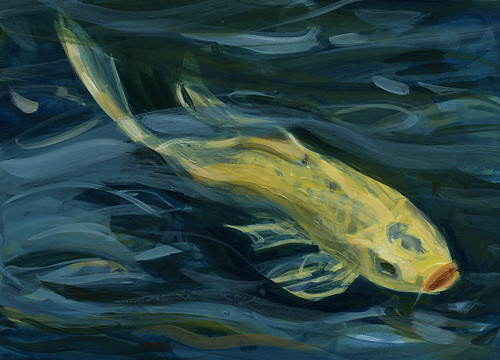
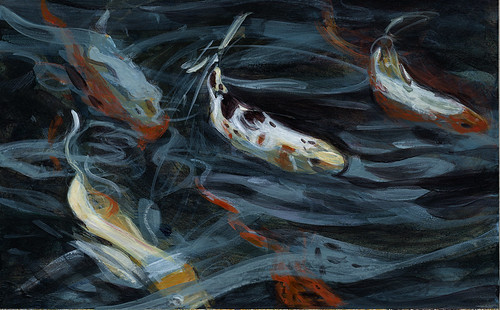
I am so glad I decided to make a series of 30 small studies (emphasis on STUDIES) of koi in water ---you cannot imagine how much fun I'm having!! I have painted in acrylics on a large-ish scale so intermittently over the last few years, that I had really forgotten a LOT about technique. The same thing happens when I don't cook ambitiously for a while. I forget nuances of flavoring and method. Which is odd since I've been a pretty avid cook all my adult life, but there we are.
I have already moved on a bit, technically, from this batch of four, so I thought I'd better share with you THESE in a batch, so whatever progress and direction my process reveals will be clearer to you and to me.
At this point, I promise you that I have NO idea where all this is leading! That it will lead somewhere interesting, I have no doubt---fish by fish, swirl by swirl.Koi study series:ochreKoi study series: yellowKoi study series: concentricKoi study series: multi
I have to stop myself from fiddling endlessly with these, stop myself from wanting to get everything "right"----they are teaching me so much as they are. Now, on to the next group of four!

Saturday, 6 February 2010

Koi on masa


I have completed a painting of a koi carp pool, thanks to a blizzard removing the distractions of tv, telephone and internet for 24 hours.  Its on a half sheet of masa which is then glued onto a half sheet of Bockingford 140lb watercolour paper.  The full painting is below, and a close up of two of the fish in the top image.


The process is a little time consuming in the set up but once that is complete it's fairly straightforward in watercolour painting.  However, masa paper does become quite fragile when wet, so manipulating the paint on the paper is impossible without it turning to fibres under your brush, then tearing.  So painting on this makes you think carefully before you place your brush and to let layers dry throughly before adding more.


I'm working on another fishy piece using the same technique that's coming together slowly and I will give you a sneak preview of it now.  You can visit my blog  - Illustrated Life - over the next few days to see more and to read details on how the whole thing is created using this technique.


Tuesday, 11 August 2009

Water in a Japanese Garden


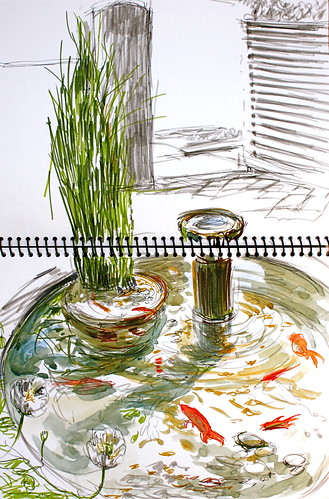
My usual choice of watery subjects are rivers, estuary or sea. Here I have been drawn to water on another level altogether. A small koi pond in a beautifully peaceful Japanese Garden. The slow rhythm of a dripping bamboo spout, the perfect circles on the water and the fleeting flashes of Koi beneath the surface calm the senses. While the cool greens and mixed textures of moss and ferns sooth the mind. To watch such things bring a powerful feeling of peace, to paint them busies the mind but also smooths out the furrows.

A3 Moleskine sketchbook. Watercolour.

Monday, 8 June 2009

June 8th is World Oceans Day

Today is the inaugural World Oceans Day - with the theme “Our oceans, our responsibility”.

It's also the day that a new film asks us to imagine a world without fish.

Oceans cover 70% of the world and are vital to
  • the regulation of the global climate
  • the balance of the ecosystem
  • the sustenance of people 's livelihoods around the world.
Greek Fishing Boats
(Pastel 19.5 x 25.5")

copyright Katherine Tyrrell

An increasing number of countries have been celebrating World Oceans Day and our connection to the sea on June 8th since a UN Conference in Rio de Janeiro in 1992.

Last year, the UN General Assembly finally confirmed that, as from 2009, 8 June would be designated by the United Nations as “World Oceans Day”.
The oceans are essential to food security and the health and survival of all life, power our climate and are a critical part of the biosphere. The official designation of World Oceans Day is an opportunity to raise global awareness of the current challenges faced by the international community in connection with the oceans.......The theme of World Oceans Day, “Our oceans, our responsibility”, emphasizes our individual and collective duty to protect the marine environment and carefully manage its resources. Safe, healthy and productive seas and oceans are integral to human well-being, economic security and sustainable development.
Secretary General, UN
Damage to the oceans
Eating fish is good for us, but catching it in the way we do devastates the sea. Nearly nine tenths of European stocks are overfished, and around a third are beyond safe biological limits: that is, the adult population is too depleted to provide replacement stock. Almost all cod caught in the North Sea have not had a chance to breed.
The Guardian - World oceans day: all the fish in the sea
Here are some of the human activities and other changes which we need to be concerned about:
  • Overexploitation - through illegal, unreported, unregulated fishing and other destructive fishing practices - is severely damaging important fisheries and vulnerable marine ecosystems, such as corals.
  • Fisheries are also being damaged by invasive alien species and marine pollution, especially from land-based sources.
  • Climate change has produced an increase in sea temperatures, sea-levels are rising and there has been a rise in ocean acidification - all pose a further threat to marine life, coastal and island communities and national economies.
  • Criminal activities threaten lives and the peace and security of the oceans. Piracy and armed robbery against ships threaten the lives of seafarers and the safety of international shipping, which transports 90 per cent of the world’s goods.
  • Lives are also threatened through the smuggling of illegal drugs and the trafficking of people by sea and across oceans
Raising awareness

The Ocean Project has been one of the organisations which has been promoting the notion of World Ocean Day and for the last six years it has been helping aquariums, zoos, museums, conservation organizations and agencies, universities, schools, and businesses to celebrate World Ocean Day.

It's got a very well developed website which is well worth exploring. Here are some of the aspects which are worth taking a look at:
You can also read more about it The Guardian's Editorial today World oceans day: all the fish in the sea

I learned about World Oceans Day through Stephen's Fry's 'tweet' about the film The End of the Line which asks us to imagine a world without fish

Do you eat fish and like fish? I do and that's why I've told you about World Oceans Day. If you're concerned too why not tell somebody about what's happening today?

Sunday, 15 March 2009

Seeing spots

Trout in progress watercolour, pen & ink

Crop showing pointillism

Progress, watercolour and start of pen and ink overlay

When you have a fish with dark pigment on it what else could you call it but Spot? When you add pen and ink in pointillism it reinforces the name.

I have been submerged in fish lately from prints to paintings as well as other elements of life that have taken over a bit including a shoulder problem that's made painting a bit challenging this week.

This particular piece started out as a study for planned piece. I want to experiment with some watercolour pours and add either fish prints or paintings to the full sheet. So I was seeing how a painting of a fish would look and it seemed to take on a life of its own.

Trout are fairly covered with minute black spots and larger areas of darker pigmentation. I started out in watercolour but it didn't give me the detail that I wanted. I pulled out a .25 Rapidograph pen and started adding tiny dots to create shading and the pigmentation. This method of working is very time consuming but I greatly enjoy it and it becomes almost soothing to sit there dotting away for ages.

I also laid my hands on a few bottles of irridescent acrylic ink and added tiny touches of this to the watercolour wash. I don't want the piece to be completely shiny and artificial looking, just make the viewer wonder if its their eye or is it really a little irridescent.

This is a piece in progress as I haven't completed the ink or the watercolour layers yet and will continue to slowly build them.

A friend's pond full of expensive koi carp was hit by deep ice and cold and a number of the fish died and were presented to me half frozen in a bag one evening last week. I haven't had a chance to do much with them this week, but they look promising as the scale pattern is so pronounced on the carp. I took one print but the fish wasn't thawed enough so the ice melted a little even after drying the skin and interfered with the ability to get a clear print.

I've continued to work on the original fish prints that I made with a rainbow trout and am creating both cards and paintings with them.


They seem to bring out a looser side of me and using brighter colours and abstract shapes is very freeing, even if going back to detail always appeals to me.

Its another part of Watermarks that I am grateful for - the push to experimentation and exploration. Thank you!

Tuesday, 3 March 2009

A sketchy hint of things to come!

I mentioned I'd found a watery place to go and paint about two 1/2 hours from here and I'm SO excited! In the meantime, here's a not unrelated (got that?) sketch I did last week in Austin, Texas. Sometimes painting is the most fun thing in the world to do! (Sometimes it's hellish, but we'll leave that thought for another day.) I 'll be at the Mystery Place a week from this weekend, if the weather's good. Cross your fingers for that good weather, please!San José Hotel fish pond, Austin, TX.

Sunday, 11 January 2009

One Fish Two Fish Red Fish Blue Fish

The title of this post is from the Dr Seuss book of the same name and it kept running through my head as I did this printing process. But aside from having fish and colours in it, it has little to do with this post.

The aquatic theme still finds its way into my work and here into Watermarks. This stylized fish was from an old piece that I had done years ago and now translated into a lino print.

I've been looking longingly at lino printing for awhile and decided that it was about time to plunge in. The full process from design to print can be read on my blog, Illustrated Life and today I have played around with some more colours and papers to see what I could come up with.

My next experiment will be to add other colour or texture to the pieces after they have dried. Right now they are being printed on 9 x 6 sheets of anything from plain old sketch paper to Somerset and this black smooth paper which I can't remember the name of.

So what have I learned from this so far?

1. Choose your design carefully. It needs to be something that translates easily to lines and value blocks. I'm sure you can create something as complicated as you like, but I think that less is often more.

2. Think 10 times and cut once! Deciding on what will be printed with ink and what will be cut away can be a challenge as you're working in reverse, almost a negative effect. I found some thumbnail sketches trying out various values works well to give me a good idea of what looks good or not.

3. Have the right tools - or close to it. In my need for instant gratification, I accessed most of the tools I wanted locally but not all of them. While my final prints didn't turn out too badly, some finer gouges and a baren would have helped, as well as access to a broader selection of lino blocks. Thank heaven for mailorder!

4. Research. Despite my need for instant gratification, I did take time over the past week to do a lot of reading on lino printing and watched a lot of videos on the process. It really makes a difference to me to have both written words to reference and the visuals of watching someone actually completing the process.

Wednesday, 31 December 2008

Four fish out of water

The Lynn Painter-Stainers Fish
14" x 18", coloured pencils
copyright Katherine Tyrrell

Following on from Jeanette's post yesterday about her fish, I thought I'd post a drawing I did recently while sat in the middle of the exhibition for the Lynn Painter Stainer's Prize! (see Lynn Painter-Stainers Prize 2008 and Exhibition)

It's very odd drawing a still life (involving what I think were herring) sitting in the magnificent Livery Hall hall of Painters' Hall - the home of the Worshipful Company of Painter-Stainers in the City of London - but that's what I did.

I should explain - that I was trying one of the workshops run during the exhibition. It's really nice sometimes to turn up for a still life set up by somebody else and all you have to do is decide what angle you're going to draw it from!

I took one of the large pieces of paper on offer and used my own coloured pencils. I used my camera to work out the four lines for cropping the image and drew out a pencil 'frame' on the paper in which to work. I then adopted my normal approach to sketching plein air which is to scribble using an open hatching method. It's also a good approach when working on paper this big and in a limited timeframe (this took about an hour or so).

Drawing on paper you're not used to is always interesting with coloured pencils as I never quite know how it's going to react. With some papers the coloured pencils just sink in and on others it's really difficult to get good darks. This one was slightly veering towards the latter and it took some time to get darks associated with the scales and shadows of the plate down.

I wouldn't have chosen fish to draw as a still life but I really enjoyed this and I'll certainly do some more in the future.

Tuesday, 30 December 2008

A fish out of water

Fish out of Water
5 x 10 watercolour

I received a book of handmade watercolour paper for Christmas. I love new paper, especially hand crafted, but am always loathe to start it. Its as if I need to make sure the first piece is fabulous and all the others follow suit, which, of course, never happens.

I also received a lovely new set of 36 Faber Castell watercolour pencils as well and they are the perfect marriage with the paper and my current set of old watercolour half pans. So then inspiration struck. I'll dedicate this book to Watermarks pieces.

I'm still refreshing my skills in watercolours so there will be the usual mix of good, bad and ugly, but they'll stay within the book and depending on how prolific I get, I may need a second book.

A brace of rainbows
5 x 10 watercolour

I've started out the book with a couple of watercolours which are indeed water-related. Fish! The first watercolour is a combination of a variety of fish species. To me it looks more like a mackerel at least in colouring and definitely more colourful than the average grey/brown tom cod that swims in local waters. The second is a pair of rainbow trout. Trying to capture the irridescence of scales and the sheen of the skin will take practice, but I love the colours that come through and that can be found in fish of all types.

Watercolour seems to be the logical medium for depicting water creatures or water itself. Even though I live on an island, I don't eat as much fish as I could and have a fairly severe allergic reaction to shellfish, which makes me wary of all seafood. I think the build up of toxins in the ocean play a strong role in the increased numbers of allergies experienced with shellfish and ocean fish at times too.

When John Cabot arrived on the shores of Newfoundland 500 years ago, cod was so plentiful that sailors could reportedly scoop them up into their ships with buckets. For Cabot and other early explorers and settlers, Newfoundland's cod was an oceanic jackpot that fostered a lucrative fish trade between North American and European countries.

In 1997, however, the Newfoundland fishery that once drove the province's economy is in a slump. In 1992, the federal government declared a moratorium on cod fishing because of devastatingly low cod stocks. Closing the northern cod harvest put 30,000 Newfoundlanders out of work. By 1993, all Canadian cod fishing was banned

There is, in most year, a week or two allowed by the Federal government of 'recreational' fishing in Newfoundland with a quota of 5 fish per day per person. This doesn't sit well with inshore fishers who maintain, as many do, that the death of the cod fishery lies in the hands of some countries who use large trawlers to harvest cod off Canadian waters as well as scrape up everything in their path, destroying habitat and other species.